

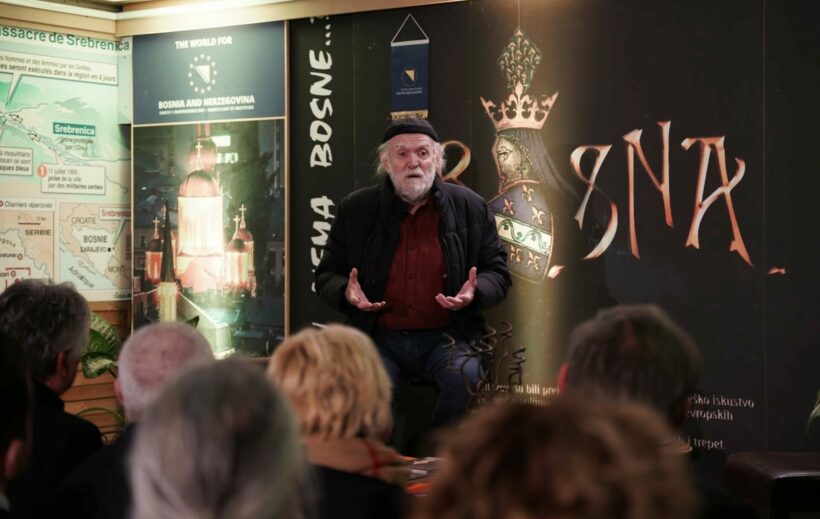
The artistic world of Bosnia and Herzegovina, and far beyond, is mourning the loss of one of its greatest talents: Josip Pejaković. An actor, writer, playwright, and iconic figure of Bosnian-Herzegovinian culture, he passed away in Sarajevo at the age of 77, during the night of July 18 to 19, 2025. A true living monument of the stage, he leaves behind a monumental body of work, defined by unwavering sociopolitical engagement and profound humanism.
Born in 1948 in Travnik, the former capital of the Bosnian Eyalet (Eyālet-i Bōsnâ) between 1699 and 1850 and also known as the birthplace of Nobel Laureate Ivo Andrić, internationally renowned for the novel “The Bridge on the Drina”, Pejaković completed his primary and secondary education there. It is also where he began his artistic journey as the lead singer of the local rock band Veziri, before fully dedicating himself to the theatre. He graduated in acting from the Drama Studio in Sarajevo, studying with Kaća Dorić and Josip Lešić. He made his stage debut shortly thereafter, performing in demanding works such as Anton Chekhov’s “Three Sisters”, in the role of Baron Nikolay Lvovich Tuzenbakh, and the “Concert in an Egg” (Concert dans un œuf) by Fernando Arrabal. His deep voice and commanding stage presence quickly earned him widespread recognition, captivating audiences of all ages.
Over the decades, his artistic longevity, discipline, and charisma made him a central figure in Bosnian theatre, and more broadly, a towering presence across the former Yugoslavia and the wider Southeast European region.
Pejaković was also an outspoken critic from the very beginning of the Balkan conflicts that followed the dissolution of the former Yugoslavia. He became one of the most prominent and vocal anti-war activists, an engagement that gave rise to several acclaimed works, including “O, izbjeglice” (Oh, Refugees). During the Bosnian War, he served as the Commissioner for the Rescue of Cultural Assets and managed to save several books from the flames as the National Library in Sarajevo’s Vijećnica building burned. In the years that followed, and in line with his enduring convictions, he joined the editorial board of the progressive magazine Novi Plamen (“The New Flame”), which now exists only in digital form, thus contributing to shape the publication into a vital platform for political, social, and cultural debate in the post-Yugoslav region.
From 1970 to 2013, he was a permanent member of the National Theatre of Sarajevo, the largest theatre in Bosnia and Herzegovina and one of the most important cultural institutions in Southeast Europe since its founding in 1921, where he performed in over 50 leading roles. He is celebrated there for his powerful interpretations in classic works such as “For Whom the Bell Tolls” by Ernest Hemingway, “The Tragedy of King Lear” by William Shakespeare, “Acting Hamlet in the Village of Mrduša Donj (Predstava Hamleta u selu Mrduša Donja)” by Ivo Brešan, and “The Brothers Karamazov” by Fyodor Dostoevsky.
In addition to being a celebrated actor and respected intellectual, Pejaković was also the author of numerous powerful and politically engaged theatrical monologues, including “Kako, bolan, nema Bosne”, “On meni nema Bosne”, “Oj, živote”, “O, izbjeglice”, “Država i papci”, and “Ućerivanje”. Staged throughout the entire former Yugoslavia, these and many other works confronted the traumas of war, exile, identity, and collective memory with unwavering honesty, blending dark humour, tenderness, and defiant rebellion.
The newly elected Mayor of Sarajevo, Samir Avdić, paid tribute to Pejaković and the enduring cultural legacy of the city, stating: « Pejaković was an artist of the people; he was the voice of conscience, the guardian of identity and a brave witness of the times. His word and message live on, as a lasting reminder of the power of art to change the world ».
Over the course of more than fifty years, Pejaković received numerous awards and honours both in Bosnia and Herzegovina and abroad. As early as 1974, he was awarded the Gold Medal at the Zemun Festival for “Oj, živote” (Oh, Life) and the following year he received “Sixth of April Award of the City of Sarajevo” (Šestoaprilska nagrada grada Sarajeva), named after the day commemorating the city’s liberation from fascist occupation during World War II. This is the highest honour bestowed by the City Assembly of Sarajevo, awarded for sustained excellence and contributions in fields such as science, business, education, technology, healthcare, art, sports, and human rights. In 1977, he received the prestigious “Sterija Award” for artistic achievement at the Sterijino Pozorje Theatre Festival, held annually in Novi Sad (Serbia), and named after the renowned playwright Jovan Sterija Popović, for his interpretation of Omer Pasha Latas. This marked the beginning of a long list of lifetime achievement recognitions. He received several accolades from various associations of dramatic artists in Bosnia and Herzegovina, including the ZAVNOBiH Award for Lifetime Achievement in 1991. In 2008, he was honoured with the Ring of Tmača Award for his interpretation of “Long Day’s Journey into Night” by Eugene O’Neill, and in 2012, the Muci Silver Award for his performance in “Acting Hamlet in the Village of Mrduša Donj (Predstava Hamleta u selu Mrduša Donja)” by Ivo Brešan, inspired by Shakespeare’s Hamlet.
In 2018, he received one of Bosnia-Herzegovina’s highest theatrical honours: the Zlatni lovorov vijenac (Golden Laurel Wreath) from the MESS International Theatre Festival held annually in Sarajevo since 1960, which is the oldest surviving theatre festival in the Balkans. Founded by Jurislav Korjenić and originally dedicated to experimental theatre under the name “Festival malih i eksperimentalnih scena Jugoslavije (Festival of Small and Experimental Stages of Yugoslavia)”, the festival is globally renowned for showcasing international experimental performances and emerging artists and praised Pejaković « not only for his artistic engagement, but also for his social commitment, uncompromising opposition to war and nationalism ».
Alongside his theatre work, Pejaković also appeared in impactful films and TV series such as “Silent Gunpowder” (Gluvi barut, 1990) by Bahrudin Čengić, “The Perfect Circle” (Savršeni krug, 1997) by Ademir Kenović, and “All for Free” (Sve džaba, 2006) by Antonio Nuić, further confirming his versatility and talent as a screen actor. A rare multi-talented artist, he also served as a theatre director at the National Theatre of Sarajevo between 2001 and 2003. In 2021, he was named honorary member of the Bosnian-Herzegovinian American Academy of Arts and Sciences (BHAAAS).
His deep passion for Bosnian culture led him to write a book on ‘sevdalinka’, published by Art Rabic in May 2022, in which he defends the urban, melancholic, and poetic form of singing born from the encounter between Slavic and Ottoman traditions that gave rise to the musical genre also known as ‘sevdah’. Together with the Montenegrin musician Antonije Pušić (known artistically as Rambo Amadeus), he advocated for the inclusion of sevdalinka on UNESCO’s Representative List of the Intangible Cultural Heritage of Humanity, a recognition that was officially granted in December 2024.
Today, the study and practice of sevdalinka is passed down through families, schools, conservatories, and music workshops, serving as a powerful marker of identity and cohesion for the country’s diverse communities, regardless of ethnic or cultural background. This richness, too, stands as part of Josip Pejaković’s enduring legacy, a broad and profound testament to his far-reaching cultural commitment. An artist beloved by all generations, across affiliations and divisions, his body of work offers both a searing critique of society and a wounded love song for a tormented land, where culture was never silenced, not even under siege or the gaze of snipers.
Despite the severe deterioration of his health, Pejaković remained remarkably active until the end of his life. In the past decade alone, he underwent 17 surgeries, yet never ceased writing, performing, or championing Bosnian Herzegovinian culture through his constant presence at conferences, public events, and also travelling across Europe. In early March 2024, for instance, he travelled to Brussels for several institutional meetings and gave two performances to mark Bosnia and Herzegovina’s Independence Day, held on March 2 and 3 at the MIR Cultural Circuit.
His final performances took place barely two months ago, on May 19 and 20, on the main stage of the National Theatre of Sarajevo, where the monodramas “Tugoslavia” and “Država” were performed.
The official funeral ceremony will be held today, Wednesday, July 23rd, at 1:00 PM at the Bare Cemetery in northern Sarajevo. Then, a public tribute to Josip Pejaković’s theatrical and cinematic legacy is scheduled for Monday, September 15th, beginning at 7:30 PM at the Sarajevo National Theatre, on the very date originally scheduled for the long-anticipated premiere of ‘Omer Pasha Latas’.



